How I started getting my gut health back on track
For months, days could pass without a proper bowel movement. I would sit in the bathroom for ages, trying, with hardly anything happening.

When I finally did go, it often felt difficult or unfinished. Then came the bloating, the tight waistband, and another uncomfortable day spent wondering when I would feel normal again.
I laid the packets out beside my notebook.
My husband thought I was adding up the money. I was, at first. Then I drew a line down the page and wrote a question at the top of the other column.
What was I actually expecting each of these things to do?
I could explain why I had bought every one of them. A recommendation. A convincing label. An evening when I had felt desperate enough to believe another enthusiastic comment. But when I tried to answer that second question, I kept stopping.
The cupboard was full. That column was almost empty.
I remember sitting with the pen in my hand, looking at the difference. All that effort, and I still had no clear way to explain the choice I was making next.
That was the morning I began looking at Daily Digestive Support differently. Before I explain why, I need to tell you what brought me to that table, because the packets were only the part anyone could see.
I was sixty two, and I had started living around the possibility of another difficult morning.
If someone suggested lunch, I thought about the bathroom. If my husband suggested a drive, I thought about how long we would be away. If our daughter asked us to stay after dinner, I began preparing an excuse before I had even answered the invitation.
I had become very good at sounding casually unavailable.
Busy that afternoon. A little tired. Something to finish at home. I used explanations so ordinary that nobody had a reason to question them.
Meanwhile, I was counting days in my head and trying to remember whether the last bathroom visit had really felt finished.
By late afternoon, I sometimes held my waistband away from my stomach while sitting down. If someone came into the room, I moved my hand. I kept a cardigan nearby because it made me feel less exposed when my middle felt swollen.

There was gas, too, and the effort of finding a quiet excuse to leave the room. My husband would be telling me something, and I would miss half of it while deciding whether to stand up.
I hated asking him to repeat himself. He sometimes looked as though I had stopped being interested in the life we were sharing.
I was interested. I was also uncomfortable, distracted, and increasingly embarrassed by how much attention an ordinary bodily function could demand.
The worst part was how reasonable every little adjustment seemed.
Getting up earlier before an outing. Wearing different trousers. Checking the route. Eating less because I hoped it would make the afternoon easier. None of those decisions looked important on its own.
Together, they were taking pieces out of my day.
One Saturday, my sister asked me to help choose something for a family celebration. We used to enjoy those afternoons. A few shops, a coffee, opinions neither of us had been asked to give.
She came out of a fitting room wearing a jacket she clearly liked. I told her the color suited her, then asked whether we could leave soon.
Her face changed. She thought she had kept me waiting too long.
I told her I had a headache because I could say that without explaining anything else. On the drive home, she talked about shoes while I held the seat belt away from my abdomen.
When she dropped me off, she apologized.
That was what stayed with me. She had apologized for an afternoon I had wanted to spend with her, because I had given her the wrong explanation for wanting it to end.
I went inside determined to sort myself out before the celebration.
The first thing I tried
My first serious plan was water. I bought a large bottle with markings down the side and kept it beside the kettle. Every time I passed, I drank some more.
It felt sensible. It was also easy to measure. I could look at the bottle at the end of the day and know I had done what I intended.
I wanted my digestion to give me an equally clear answer.
Instead, I had mixed mornings. Sometimes I went. Sometimes I waited. Sometimes I passed something hard and uncomfortable, and sometimes I went but still felt as though there was more to do.
I began setting the alarm earlier, as if leaving more time would make the experience more predictable. My husband would knock gently and ask whether he should put the kettle back on.
I said I would only be another minute.
I rarely knew whether that was true.
When extra attention to drinking did not settle everything, I decided I had overlooked something else. Fiber sounded like the obvious next step, so I changed breakfast.
Then I changed lunch. Then I bought a powder because I wanted to feel I was doing something properly, rather than hoping a different cereal would be enough.
For a while, I approached the whole thing like homework. Remember the water. Remember the breakfast. Remember the powder. Keep going long enough to be able to say I had really tried.
But there were days when I felt more full and gassy. I could not tell which change belonged to which feeling because I had made several changes close together.
I had created a complicated experiment and kept almost no useful record of it.
That did not stop me blaming myself when the answer was unclear.
Perhaps I was inconsistent. Perhaps I had chosen the wrong thing. Perhaps everyone else knew a simple rule I had somehow missed.
One morning, I stood at the kitchen counter holding the powder and felt close to tears. I was angry with an object I had bought because I thought it would make mornings easier.
I put it back in the cupboard before my husband came downstairs.
That became a habit: arranging the evidence before anyone could see how disappointed I was.
Then I started taking things away
After adding things failed to give me a dependable answer, I started taking things away.
Bread became a suspect. Then milk. Then a sauce we had eaten for years. I would feel uncomfortable after a meal and mentally go through every ingredient, trying to identify the mistake.
If I had a better afternoon, I became nervous about eating whatever I had left out. If I had a worse one, I looked for another thing to remove.
Soon the rules were changing faster than my husband could follow them.
One evening, he stopped chopping vegetables and asked what I actually wanted for dinner. I said anything would be fine, then asked what he was putting in the pan.
He set the knife down.
I realized how often I had made him responsible for restrictions I could not explain. He was trying to cook us a meal. I was trying to make the meal guarantee an outcome neither of us could predict.
We ate quietly that evening. I missed asking for something simply because I liked it.
There were other attempts. Prunes. A tea someone mentioned. A warm drink before breakfast. Walks after dinner. Advice gathered from friends, comments, and the sort of search that starts with one practical question and ends with fourteen open pages.
The walks should have been a pleasure. We had time together, and there was always something to notice in the neighborhood. Instead, I kept checking whether I felt different yet.
Halfway around the block, my husband would point out a garden, and I would be privately assessing my abdomen.
I was turning time with him into another test.
Eventually, he asked whether we could finish a walk without deciding whether it had worked.
I knew what he meant. I also knew how difficult I would find it.
Everything had become a possible answer, which meant everything could become another disappointment.
Then came the pharmacy visits. I chose quiet times because I did not want anyone standing behind me while I explained. When someone asked what was happening, I gave a shorter version than the one I was living.
I wanted useful help while avoiding the details that would make the conversation useful.
What I tried did not always do nothing. Sometimes one part of the experience changed. Sometimes I could go more easily and still feel bloated. Sometimes I had a better morning followed by another difficult afternoon.
I struggled with that because I wanted one clear verdict.
Working or failing. Solved or unsolved. Something definite enough to tell my husband when he asked how I was feeling.
Instead, I said I was fine and opened another search later.
I began buying things in private, intending to mention them once I had good news. That way, I told myself, he would not have to listen to another hopeful explanation followed by another uncertain week.
The parcels arrived. I felt optimistic while opening them. Then I watched myself more closely, trying to decide whether the purchase had been worthwhile.
By then, I was judging an entire week by the most recent uncomfortable hour.
I could hardly remember what I had changed. I could remember every little moment of disappointment.
The cost was becoming uncomfortable too. Individually, the purchases seemed manageable. Together, they represented meals out, an evening away, things my husband and I could have enjoyed instead of things I had pushed behind the tea bags.
I had always been careful with money. I compared supermarket prices and saved wrapping paper if it could be used again.
Yet I could justify another order when I felt miserable.
Perhaps this was the thing I had missed. Perhaps I would regret giving up just before finding it. Perhaps spending a little more was reasonable after spending so much time struggling.
I could make each purchase sound sensible. I could not explain the collection.
Our daughter suggested a few days away near the water. She sent photographs of a little place with a table outside and enough room for the grandchildren to spread out.
My husband liked it immediately. I asked about the journey, the bathrooms, the meals, and how far we would be from a shop.
They were ordinary questions, but I could hear what they were doing to the conversation. A pleasant possibility was becoming a problem everybody needed to solve for me.
Later, he asked whether I actually wanted to go.
I said yes, then started crying because wanting to go and feeling able to enjoy it had become separate questions.
We left the booking unfinished.
That night, I looked at the photographs again. I could picture the children at the outside table. I could also picture myself inventing a reason to go indoors while everyone else stayed together.
The question I could not answer
The next morning, I bought the notebook.
I had gone out for birthday wrapping paper and picked it up almost without thinking. Plain cover. Lined pages. Something familiar enough to make a messy problem look manageable.
I thought I would list what I had tried, add up the cost, and decide what to do next.
That brought me to the kitchen table with my husband watching and the second column almost empty.
I started with the easy things: names, packets, prices. Then I tried to write what I had expected from each purchase and what had actually happened.
Those were different questions. I had been treating them as though they were the same.
I expected an easy morning. I expected less swelling. I expected to stop worrying about lunch. But those expectations did not tell me what the product was intended to do, whether it fitted my circumstances, or how to judge it fairly.
I had been choosing the picture of life I wanted, then asking the label to fill in the explanation afterward.
My husband pulled out the chair beside me.
I began defending the money. He listened for a while, then asked me to explain what had been making the days so difficult.
That was a harder question, and it was the one I needed.
I told him about the clothes shop. The quiet searches. The bathroom calculations before every outing. The way I sometimes let the phone ring because answering might lead to an invitation I would need to avoid.
He listened without reaching for another packet.

When I finished, he asked why I had been trying to tell him only after I had found an answer.
I did not have a good reason. I had confused keeping the problem private with keeping it small.
We made a better list together. The symptoms I could describe. What I took, including medicines for other things. What had changed. The questions I had never followed up because I had moved on to the next purchase.
Then I arranged an appointment and took the list with me.
I nearly shortened it in the waiting room. There is a temptation to present the version that sounds tidy and easy to deal with. I resisted it long enough to explain the pattern and how much it was affecting ordinary life.
There were questions about my health and routine, things to review, and next steps to follow up. I could bring a label into that conversation. I could explain mixed experiences without having to call everything a success or a failure.
That gave me a way to keep looking without starting from scratch every time.
At home, I went back to the empty column and changed the question.
Which part of the problem am I asking this choice to support?
That was the first question that made the cupboard less confusing.
I had been putting water, fiber, bowel movement, gas, food choices, and microorganisms into one mental box marked digestion. If something changed one part, I expected the whole experience to change with it.
The part I had been missing
Understanding the different jobs made the mixed results less mysterious.
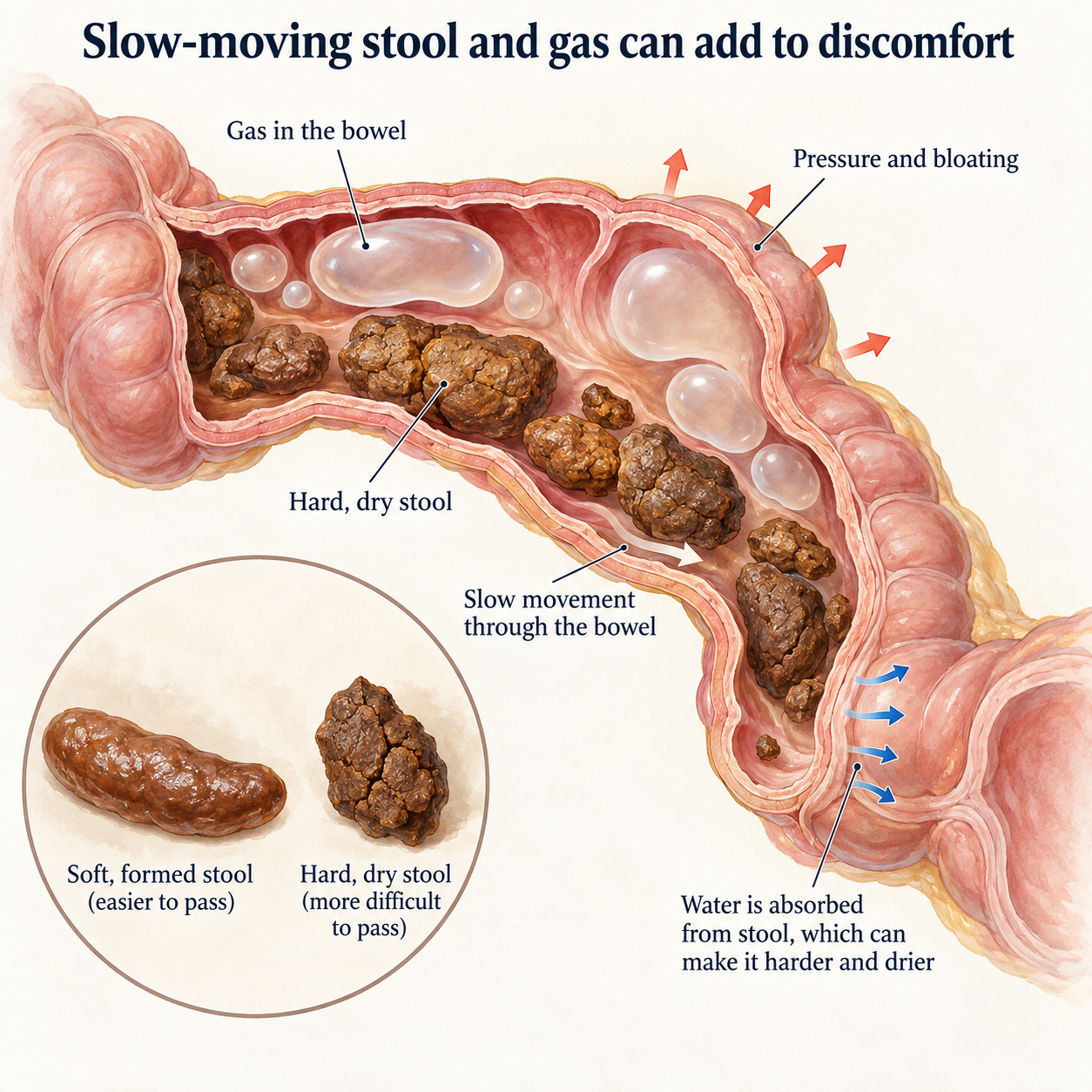
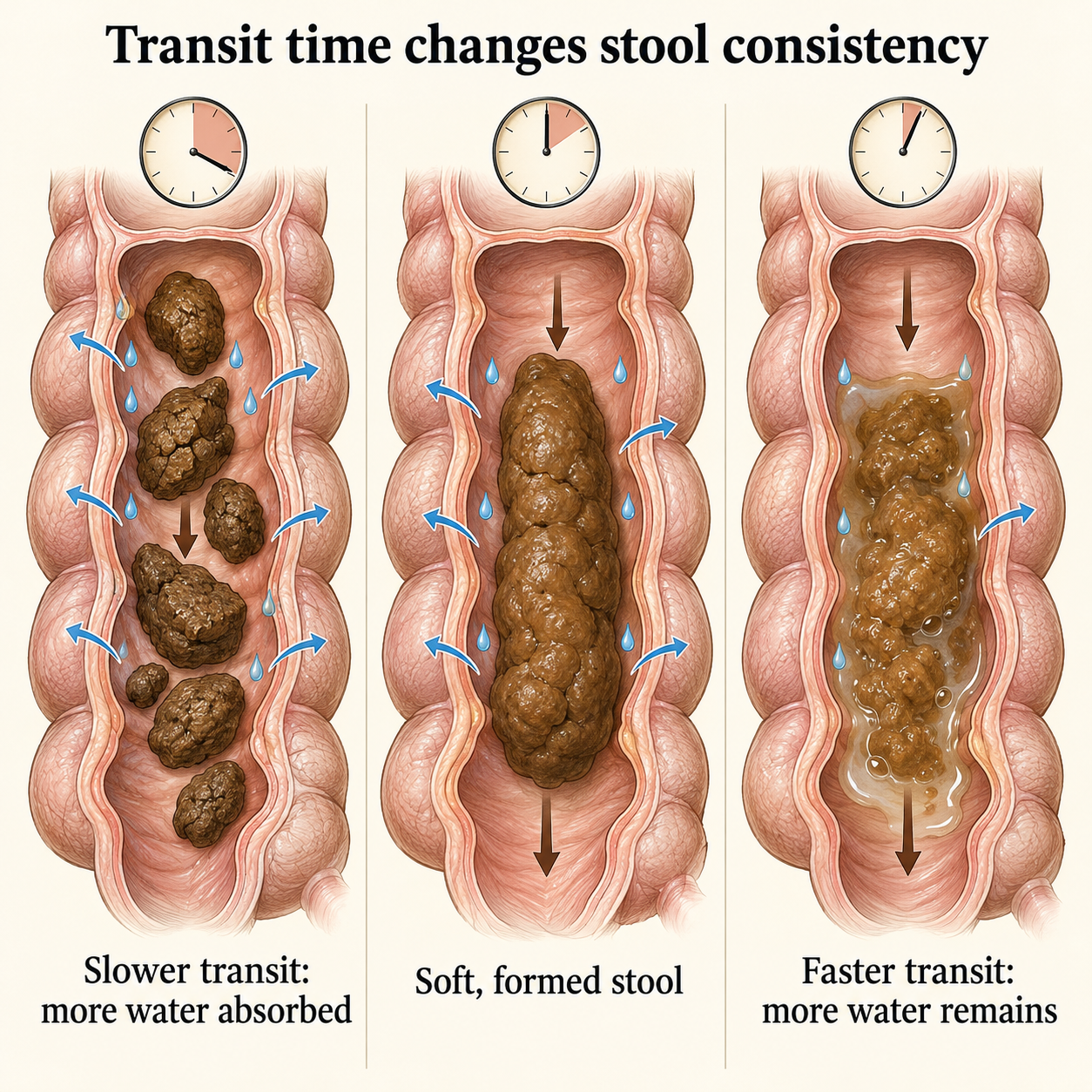
The large intestine absorbs water as material passes through it. When stool moves more slowly, more water can be removed, leaving it harder and drier. Faster movement can leave more water in the stool, making it looser.
I could finally understand why consistency and movement belonged in the same conversation.
Gas was another part of the picture. Some comes from swallowed air. Some is made when microorganisms break down carbohydrates that were not fully digested earlier. Gas and bowel contents can contribute to stretching and pressure, and constipation can occur alongside bloating.
A diagram could explain those processes without telling me which cause applied to me. That distinction mattered. I wanted an explanation I could use, rather than another explanation I would become frightened to question.
The same applied to the idea of gut bacteria.
I had read enough confident descriptions of imbalance to start treating every uncomfortable afternoon as evidence of one. But bloating, constipation, gas, and loose stools can have different causes. The symptoms alone could not tell me exactly what my intestinal community was doing.
I wrote that down because it stopped me making another leap from a familiar symptom to a convenient diagnosis.
Then I returned to the supplement category I had barely understood beyond its name.
Probiotics.
I recognized the word immediately. I could not have explained what made one formula worth considering for a particular purpose rather than another.
A large number on the front had usually been enough to catch my attention. I had spent much less time looking for the organisms behind it.
This time, I turned the label over.
Probiotics are live microorganisms. Their effects depend on the particular organisms and the amounts involved. They enter an intestinal environment where a complex community already lives and interacts.
That was a very different picture from the one I had carried around: a vaguely good ingredient that ought to make everything feel better because the bottle said digestion.
Prebiotics have another job. They are substances beneficial microbes can use as food. FOS, short for fructooligosaccharides, is one of those ingredients.
The microorganisms, and a substance helpful microorganisms can use.
I understood the pairing. I also understood why it could not tell me, by itself, that a particular product would settle every symptom I had described.
It did give me a more specific question to ask than whether another bottle looked promising.
What organisms are actually in this formula, what else is included, and does this daily support option make sense alongside my own circumstances?
Why I looked at Daily Digestive Support
That is the question I brought to Milligram Daily Digestive Support.
I was looking at the same sort of purchase I had once made at night with several hopeful tabs open. The difference was that I now had something concrete to compare with the description.
The formula combines a probiotic blend with FOS prebiotic. Four strains are named on the label: L. acidophilus La-14, B. lactis Bl-04, L. plantarum Lp-115, and L. paracasei Lpc-37.
Those names gave me details I could check. A category name had become a defined formula I could discuss.
My husband asked how that differed from the bottles already sitting between us.
The page stayed open while we talked.
I was glad he asked before I had ordered. It forced me to do something I had avoided with the earlier purchases: compare the information I actually had.
I took one of the old packets and turned it around. Then another. I looked for serving sizes, named organisms, directions, and what I had written beside each one in the notebook.
Some details were clear. Others were things I would need to check. I could not honestly explain every disappointing experience by pointing to a different ingredient. My notes were too incomplete for that, and my circumstances were part of the picture as well.
But I could see a better way to choose now.
I drew three small boxes on a clean page. In the first, I wrote what the formula contained. In the second, what I needed to establish about suitability. In the third, what I was being asked to agree to when buying it.
The questions became manageable because each one had somewhere to go.
The named strains and FOS went in the first box. My medicines and health questions went in the second. The supply options, renewal choice, and return policy belonged in the third.
I had spent months mixing those decisions together. A favorable comment had stood in for suitability. An attractive offer had stood in for understanding the formula. A better afternoon had stood in for a careful account of what I had changed.
The boxes made those shortcuts visible.
My husband read the page, then asked me which box I still needed help with. That was a question I could answer without getting defensive.
We put the packets aside and brought the current label back into view.
For once, I was not asking him to share a sudden burst of confidence. I was showing him the reasons for a decision he could follow, question, and help me think through.
I put the notebook beside the screen and wrote down what I wanted from the decision: daily digestive support I could understand, directions I could follow, and a purchase I would not have to hide from my husband while waiting to see how I felt.
That is why this bottle held my attention.
I could see the relationship between the live microorganisms and the prebiotic ingredient. I could see the serving information. I could bring the actual label into a conversation about suitability instead of trying to describe a reassuring advertisement from memory.
I was choosing based on what was there.
There are sixty capsules in the bottle. The serving is two capsules, which gives thirty servings. The declared forty billion CFU applies to that two-capsule serving, rather than each individual capsule.
That was exactly the sort of distinction I wanted to notice before buying.
The label also lists twenty four milligrams of FOS per serving. I understood it as a prebiotic ingredient in the formula. My meals still had their own role, including dietary fiber.
There was no need to turn a label fact into a larger promise to make it useful.
My husband asked what I would do differently this time.
I told him I would start with the directions and my own suitability. I would consider the supplement alongside everything else I took. I would keep the questions we had already raised instead of expecting the purchase to make them disappear.
Then I would decide how I wanted to order.
That last part might sound small. To me, it was where the previous pattern had usually taken over.
I had allowed the excitement of finding something new to make the whole purchase feel urgent. Enough urgency, and I stopped distinguishing what I knew from what I wanted to happen.
This time, I wanted to make an ordinary decision in ordinary daylight.
The product information gave me somewhere to begin. The named strains and FOS pairing explained the formula. The serving size explained the bottle. The directions and warnings explained what I needed to consider about use.
The remaining question was whether the choice fitted me.
I had learned to take that seriously. Persistent or concerning symptoms deserved appropriate advice, and severe pain, blood in the stool, vomiting, or other alarming changes needed prompt medical attention. A shopping decision belonged alongside that responsibility.
Existing health conditions and medicines mattered too. Pregnancy, nursing, serious illness, or a weakened immune system were reasons to seek professional guidance about a probiotic.
I wanted those questions answered before beginning, while I still had the label open and time to think.
What if I spent more money?
That left the question I had been avoiding since the first parcel: what if I spent more money and it was not right for me?
My husband asked it directly.
I was grateful, because I had been trying to sound confident enough to prevent him from asking.
We read Milligram's return policy together.
The guarantee runs for ninety days from delivery. It includes opened and partially used bottles. If I was dissatisfied, I could contact support within that period with my order details. Opened supplements did not need to be sent back for a guarantee refund.
That was a practical answer to a practical worry.
It meant I could understand the financial protection before choosing. I did not have to keep a bottle untouched in the cupboard to preserve the possibility of asking for a refund.
I also understood what the guarantee covered: the purchase. My expectations about digestive comfort still needed to remain realistic and personal.
Separating those questions made the decision feel less loaded.
We checked the purchase options next. One bottle or a larger supply. A one-time order or a subscription chosen deliberately, with the renewal terms in view.
I liked being able to consider those choices separately from whether the story of the product had interested me. A refill could be convenient if it fitted my plans. I could also begin with a one-time purchase if that was what I wanted.
I was the person making the choice.
The cancellation policy was clear too: future subscription renewals could be cancelled without a cancellation fee or minimum commitment, using the management link or contacting support before the next renewal was processed.
I read it carefully because I wanted to know what would happen after the first order, while I was still deciding about the first one.
That may be the least dramatic sentence in this story. It was also one of the most useful things I did.
For a long time, I had wanted to feel certain before I acted. Then, when certainty proved impossible, I bought things impulsively because feeling hopeful seemed close enough.
Now I had a different way to move forward: understand the formula, check suitability, choose the terms, and keep realistic expectations.
That was something I could do.
There were still objections I needed to answer honestly.
Had I tried enough things already? Certainly. Did that mean every daily digestive support option was identical? I had no reason to assume that. Did a named formula guarantee it was the right choice for me? That needed individual consideration.
I could be interested without handing over my judgment.
I also knew what I would watch for in ordinary life: digestive comfort, stool consistency, ease of passing a bowel movement, and whether my routine became more predictable. Those observations would help me describe my experience.
They would not diagnose a repaired microbiome, and nobody could promise which change would come first or when.
I wanted useful expectations because I had already spent enough time measuring a day against a perfect picture.
That picture had been part of the problem. I had imagined returning to every outing at once, never thinking about digestion, and somehow proving that all the money and worry had led somewhere worthwhile.
Real life required a smaller question: what would make the next decision sensible?
Daily Digestive Support was worth my attention because I could answer that question with details from its label and terms, rather than another person's certainty.
I could explain the probiotic and prebiotic roles. I could check the serving. I could discuss the actual formula. I could see the choices available and the policy behind the purchase.
My husband listened while I went through it.
Then he asked whether I wanted tea.
I laughed, partly because the first cup was still sitting there cold, and partly because I had finally managed to explain a supplement choice without asking him to believe I had found the answer to everything.
While the kettle boiled, my sister called.
She wanted to know whether I had decided what to wear to the family celebration. The one we had been shopping for when I asked to leave early.
I almost gave her the usual short answer.
Instead, I told her why I had wanted to go home that afternoon. Enough for her to understand that she had done nothing wrong. Enough for me to stop carrying an unnecessary lie into our next conversation.
She asked why I had not told her sooner.
I said I had been embarrassed.
There was a pause, then she started talking about arrangements we could make if I needed a little flexibility. Nothing elaborate. No announcement to the whole family. Just a sister understanding why an afternoon had been harder than it looked.
I could have saved us both some worry by telling her earlier.
After the call, I went back to the notebook and wrote something below the product questions.
Stop waiting for a perfect explanation before letting people help.
That was a different kind of progress from the kind I had kept looking for in a parcel.
It did not depend on a product result. It depended on a conversation I could have that day.
Later, I opened the photographs of the place near the water again. I looked at the table outside and imagined the grandchildren bringing things over for us to admire.
I still had questions about the journey. This time, I could explain why I was asking them.
My husband and I talked about a shorter trip, a familiar route, and plans we could adapt. I had been making complete predictability a condition for every enjoyable thing. We could make room for uncertainty without letting it make every decision.
I wanted that sort of room back in my life.
The formula belonged inside that larger intention. Looking after my digestion mattered because of the meals, outings, conversations, and people I wanted more attention for.
That is why I took the time to understand Daily Digestive Support instead of treating it as another hopeful name in the cupboard.
The notebook had changed the purchase before I made it.
I knew which questions belonged to the product, which belonged to my health, and which belonged to the way I had been trying to handle everything alone.
I could stop asking one bottle to answer all three.
When I returned to the product page, I was ready to make a considered choice about the formula and the supply that suited me. The label was open. The purchase terms were clear. My husband knew what I was considering and why.
That was enough to take the next step without another midnight search.
I closed the old tabs on my phone. Some had been open so long I could hardly remember what had first convinced me to save them.
Then I put the notebook in the kitchen drawer where I could find it again.
I wanted a place to keep useful questions, not another collection I would be ashamed to show anyone.
If that cupboard had taught me anything, it was how easy it was to keep paying for hope without stopping to examine the decision underneath it.
I was finished making purchases I could only explain by describing how miserable I had felt when I made them.
With Milligram Daily Digestive Support, I could point to the actual formula: named probiotic strains, FOS prebiotic, a defined serving, and directions to consider in my own circumstances.
I could point to the choices too. The supply I wanted. The purchase mode I chose. Ninety days from delivery to use the money-back guarantee if I was dissatisfied, including an opened bottle.
Those were concrete things I could understand before buying.
My husband brought over the fresh tea and moved the old cup out of the way. For the first time that morning, the table looked less like a collection of failed attempts and more like somewhere we could sit together.
I turned the screen toward him and opened Daily Digestive Support again.
This time, we began with the label, chose the terms deliberately, and left room for the rest of the day.